ERP vs CRM: the difference and what your business needs

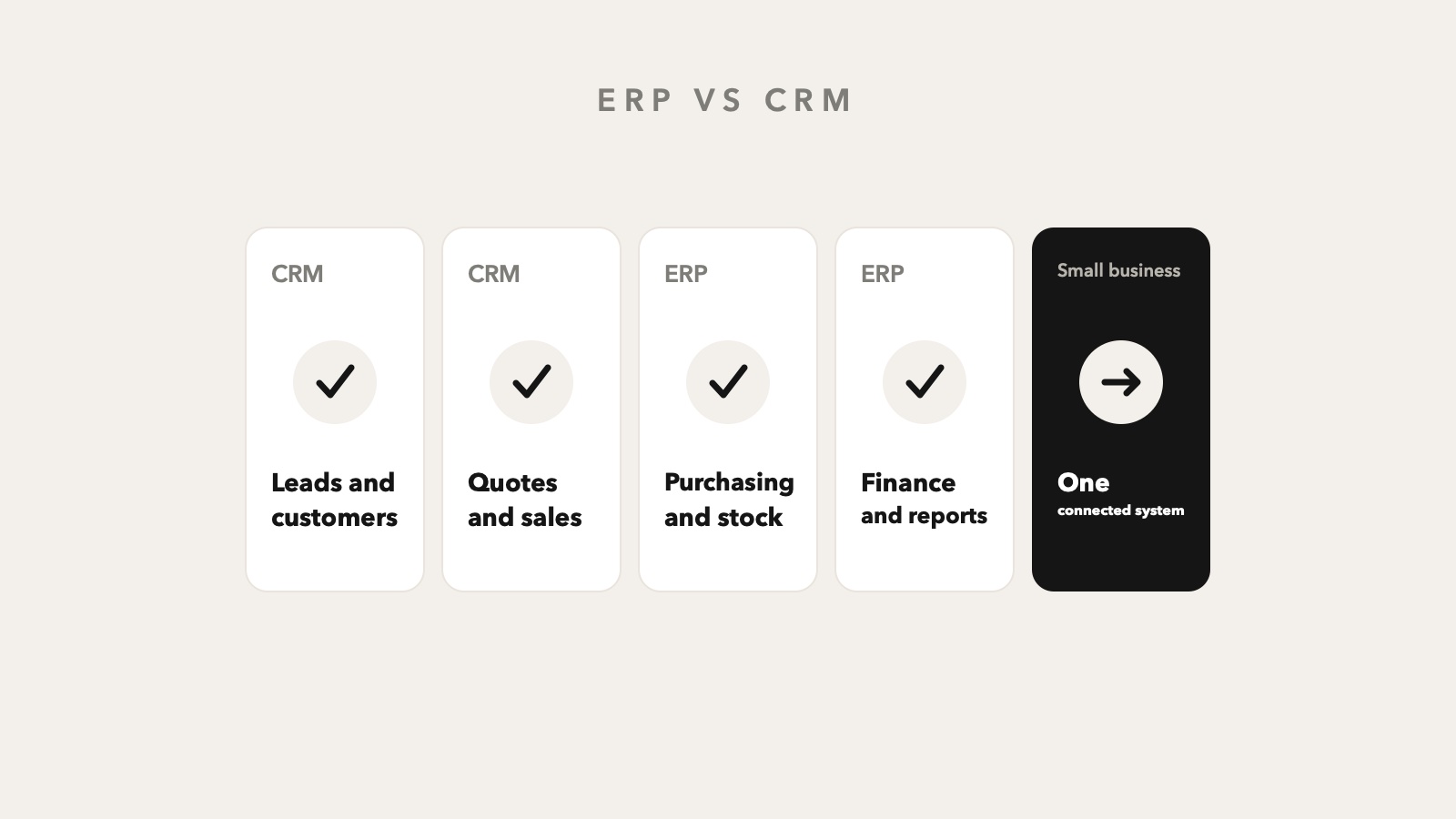
CRM and ERP get mixed up because both hold business data. The difference is which side of the company they face. CRM (customer relationship management) faces outward: enquiries, customers, quotes, sales and communication. ERP (enterprise resource planning) faces inward: purchasing, inventory, production, finance and HR.
What a CRM covers
- contacts and communication history,
- enquiries, quotes and sales opportunities,
- reminders, tasks and lead source tracking,
- contracts and, often, invoicing.
More in what is a CRM system.
What an ERP covers
- purchasing and suppliers,
- inventory and stock-taking,
- production and capacity planning,
- accounting, payroll and reporting.
What does a small business need?
- A service business without inventory usually needs a CRM with quotes, work orders and invoices. A full ERP is overkill.
- Retail or distribution needs inventory and purchasing (the ERP side) plus customers and quotes (the CRM side).
- Manufacturing needs an ERP, with a CRM useful for sales and key accounts.
Two systems or one?
Large companies buy ERP and CRM separately and integrate them, which is expensive. A small business rarely needs a full ERP or a full CRM, but one system that covers exactly its flow: from enquiry to quote, work order, invoice and payment, exchanging data with the accounting software. A custom system like that is often cheaper than two subscriptions. See custom software or off-the-shelf tools.
Not sure what you need? Start with a free business diagnostic or see custom software.
Prototype · 5 days
See your software working before you commit to the build.
Tell us which process takes the most time. In 5 days we build a clickable prototype on your real example, then agree on a fixed price.